
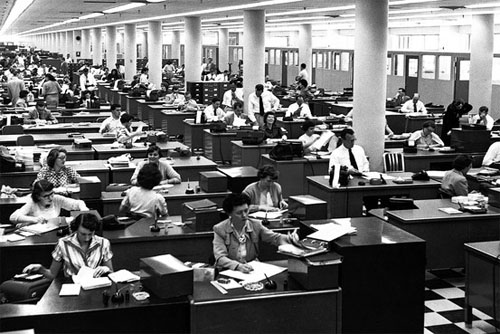
Image
Source:
Welcome
to week two, pals, this week you’re going to recognise some classical approaches
that have been utilised at least a decade ago in organisations. Even if we might
see these approaches are quite obsolete, it is undoubted that these classical
approaches construct the models of contemporary organisational communication.
It
is introduced in the lecture and textbook that there are four classical communication
approaches that had been widely employed in traditional organisations:
a) The
Machine Metaphor (Summarised by Katherine Miller)
b) Classical
Management (Developed by Henri Fayol)
c) Bureaucracy
(Developed by Max Weber)
d) Scientific
Management (Developed by Frederick Taylor)
It
is also notable that the foundations of the cultural perspective and the
emergence of cultural understanding are critical to nowadays organisational
communication processes.
The
pith of these classical approaches are still adopted in many organisations,
communication in these organisations is characterised as predominantly top-down,
formal, task-related, and written. But compared with traditional organisations,
workers are
not as interchangeable as cogs, they are instead an emotional beings exist in
an organisation. They expect to be recognised and rewarded rather than to be
seen as cogs of machine.
The
company in which I did my internship for is pretty much like a type of
organisation by which classical approaches have been widely employed. Here, I
take Weber’s bureaucracy into consideration. Read carefully, see how I could
correlate theories with practice.
When worked as internship in the
organisation, I was assigned to deliver marketing contracts, which were in
hand-written form, level-to-level for censorship and signature, from the most
basic level (marketing manager) to the highest level (director of that
enterprise).
The communication flow is shown
below:
End in with… President
of the Parent Company
(Her signature is required if total amount of the contract
over 100,000 RMB)
Chief
Executive Officer (CEO) of the Organisation
Regional
Principal of the Organisation
Chief
Financial Officer (CFO) of the Organisation
(Authorised and Supervised by the Parent Company)
Manager of Finance Department (Treasurer)
Manager of Legal
Affairs
Start with… Department Manager
It is clear that this route of
contract censorship and signature copes with the principles suggested by Weber,
that bureaucracies as working through a system of authority, power and
discipline. Each of the person in the route are hierarchically distributed and
arranged from employee level to management level. Each of those has a specific
power in the department and organisation and all of them are responsible for
every cent of cost. Hence, Weber’s theory of bureaucracy is somehow in
operation in contemporary organisational functioning.
Here is a little tip for you guys, if
you try to write an in-depth audit, textbook reading is just a beginning, go
find a job, experience it, observe it and summarise what you get.
Wit once bought is worth twice taught.

No comments:
Post a Comment